


How to choose a road bike suited to your riding style?
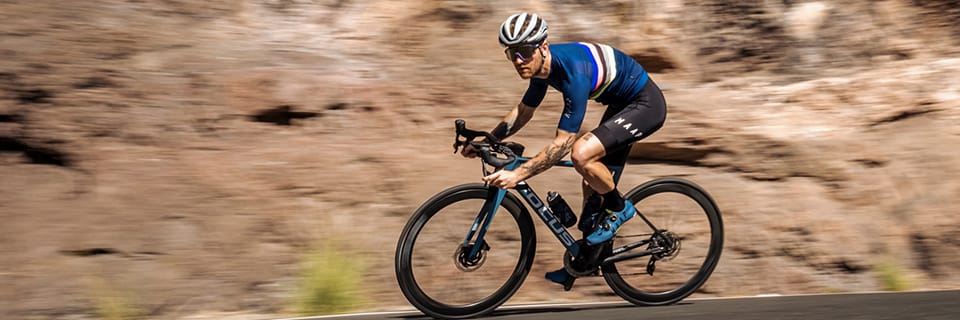
Whether in competition, training or leisure rides, your road bike will always take you further and faster. Beyond the budget at your disposal, two criteria are essential for choosing your road bike wisely: riding style and geometry.
Riding style
Cycle touring
For a good compromise between comfort, lightness and durability, an aluminium frame — ideally with a carbon fork — will be perfectly suited. On the drivetrain side, a double crankset in Compact (34/50 teeth) with a wide-range cassette (11-32 or 11-34 teeth for example) will provide maximum versatility and efficiency on all terrain.
Disc brakes will guarantee braking that is easy to modulate and reassuring in all circumstances.
Sportive cycling
An aluminium frame with a carbon fork, or a carbon frame depending on your budget, will ideally combine comfort and efficiency. As with cycle touring, a double crankset in Compact (34/50 teeth) will provide maximum versatility and efficiency on all terrain. Ideally paired with a slightly closer-ratio cassette (11-28 teeth for example) for finer and more progressive gearing.
Here again, disc brakes will guarantee braking that is easy to modulate and reassuring in all circumstances, but at the cost of greater weight compared to a rim brake system.
Competition
The pursuit of performance today necessarily involves a build around a carbon frame with an aggressive geometry, meaning a relatively low cockpit and a longer top tube for a better pedalling position and greater aerodynamics (see below for details of the different geometries). The components are also geared towards pure performance, either through their lightness (seatpost, saddle, cockpit) or their efficiency (braking and drivetrain systems).
Furthermore, it is important to choose your chainring sizes carefully according to your type of riding: Compact (34/50) will be favoured for mountain riding and positive elevation gain, while Mid-Compact (36/52) and Double (39/53) versions will be more suitable for hilly or flat routes. Wheels should not be overlooked: light and with a low profile for the mountains, slightly more deep-section for hilly routes. If you ride frequently, we would even recommend having a dedicated training wheelset and a dedicated competition wheelset.
Geometry
Geometry does not only help you choose the right frame size. It also determines the behaviour of the bike by offering a specific compromise between efficiency, comfort, weight, rigidity and aerodynamics. We distinguish three main families within road bikes.
Aerodynamic
"Aero" road bikes are designed for speed. Often wind-tunnel tested, these models are characterised by wider, more aerodynamic tubes to cut through the air. Generally stiffer, their geometry features a longer reach (frame length, measured from the upper axis of the head tube to the vertical axis passing through the centre of the bottom bracket) and a reduced head tube. The position is therefore more forward and more stretched out to maximise speed with every pedal stroke. "Aero" bikes are perfectly suited to powerful riders with a rouleur or sprinter profile.
Endurance
Endurance road bikes offer a perfect compromise between rigidity, speed and comfort. With generally longer chainstays, a shortened top tube and a raised head tube, these models are true all-round bikes. This versatility allows you to spend long days in the saddle during sportives or classics. From the mountains to the cobbles, you will get through anything with comfort and efficiency.
Mountain
These road bikes are designed to offer an optimal weight-to-rigidity ratio. They are characterised by thinner tubes and short chainstays. Their handling is more responsive, lively and agile. Lighter than aerodynamic and endurance geometry bikes, they are particularly effective for climbing the most demanding passes and making aggressive accelerations. These bikes will be perfectly suited to climbers and lovers of fresh air and mountain scenery!


