


How to dress the lower body for summer riding, on road or MTB?
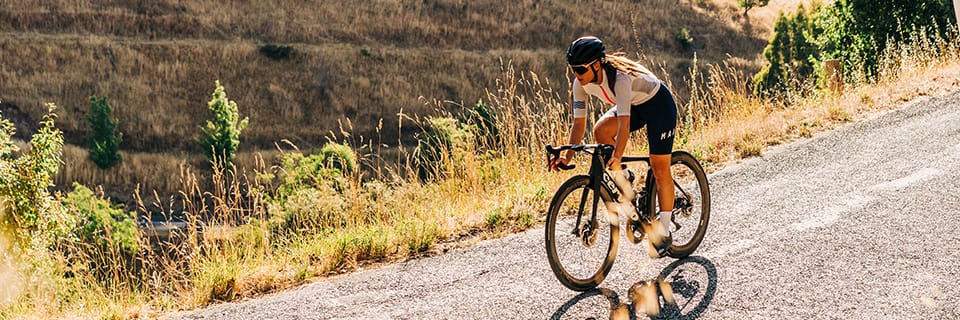
Our legs are at the heart of our cycling! Clothing them well in summer is essential for enjoyment and to optimise road and/or MTB training. Even in the height of summer, temperatures can vary depending on the time of day, altitude or simply the conditions of the day.
A few simple tips are enough to help you choose the right lower body clothing.
THE CHARACTERISTICS OF SUMMER LOWER BODY CLOTHING
- The type of garment: short bib shorts, ¾ bib shorts, long bib shorts, with or without straps, shorts, trousers, overtrousers
- Materials: technical and elastic mesh, breathable fabrics, antimicrobial technologies
EVERYTHING YOU NEED TO KNOW ABOUT SUMMER LOWER BODY ACCESSORIES
THE TYPE OF GARMENT
Short bib shorts
The bib shorts are at the foundation of cycling clothing. Even if choosing a saddle suited to your build will already provide great comfort, the bib shorts themselves can contribute enormously to enduring long hours in the saddle without pain.
Beyond the quality of the construction (anatomical cut, flat seams, or near absence of seams) and the fabrics used (compressive, very supple and elastic, ultralight and breathable, heat and UV treatment), the key to their comfort — and what often justifies their price — lies in the quality of the chamois pad.
The materials used for the padding as well as the arrangement of foams of varying thicknesses and densities will indeed have a major impact on the degree of comfort and performance.
Worn without underwear, the bib shorts are used like a second skin and are sufficient on their own for many riders. In the short version for summer, bib shorts with straps provide perfect support. Strapless versions also exist and are more convenient to remove. Integrated pockets may be present, as well as an opening for urgent needs.
¾ bib shorts or long bib shorts
When temperatures are in between, between 10 and 20°, or for riders who feel the cold, ¾ bib shorts (capri) or long bib shorts can be chosen.
Manufacturers have indeed developed long models that are not excessively warm and can be used in mid-season.
Shorts
For those looking for a more relaxed look, shorts are a good option. These can be sold on their own or with integrated bib shorts, generally clipped to the shorts and detachable, depending on taste and preference. Loose-fitting shorts with plenty of pockets are very practical and comfortable.
It is also possible to wear shorts over bib shorts (with straps) to combine the comfort and support of the bib shorts with the practicality and look of the shorts. It should be noted that in recent years, shorts have adopted an increasingly considered cut to follow the rider's shape in action so as not to move, ensuring total freedom of movement and a highly enjoyable pedalling experience. Stretch fabrics, in two or even four directions, are also increasingly lightweight while being extremely robust, with a particular emphasis on abrasion resistance.
Trousers
The trousers are far from obsolete. They can be lightweight and suitable for summer mountain rides when the weather is not ideal or uncertain.
It should also be noted that the materials used are becoming increasingly lightweight and the cuts are far better adapted than in the past to the cyclist's position, considerably increasing freedom of movement and pedalling comfort.
Overtrousers
Overtrousers represent a practical modular solution to combat summer showers. They slip on over your short clothing and can be packed away compactly once the bad weather has passed.
On the other hand, they are not designed to be worn for extended periods like trousers, notably due to their unlined materials which are not very pleasant against the skin and the often limited breathability of this type of product.
MATERIALS
Technical, elastic mesh fabrics play a major role in bib shorts. As is often the case with today's cycling clothing, these bib shorts use fabrics capable of wicking moisture away. They also provide wind protection, without causing overheating during effort thanks to their fineness.
Antimicrobial technologies can be deployed to ensure hygiene and moisture management. Finally, top-of-the-range models sometimes feature compressive fabrics that reduce and delay muscle fatigue, as well as treatments that reduce the impact of heat from the sun's rays.
WHAT CLOTHING TO CHOOSE FOR THE UPPER BODY IN SUMMER ACCORDING TO MY RIDING STYLE?
While the same jersey can be used for several disciplines, a few specific features are worth noting:
Touring
The MTB touring rider can choose either bib shorts worn on their own, or shorts with integrated bib shorts or chamois pad. A straight or relaxed fit that sits above the knee, along with lightweight materials, is recommended.
Cross-Country
Lightweight, breathable and well-fitted bib shorts give the Cross-Country rider the best comfort to push their limits. Pockets make it easy to carry the bare essentials. Moisture is wicked away by the technical fabrics, and the multi-density chamois pad means the rider can forget about their kit and focus on the race.
All-Mountain
Here, a loose-fitting, ventilated short cut to the knee or possibly ¾ length is recommended. Reinforced against falls and encounters with vegetation, it should ideally feature a comfortable inner short. The cut must not hinder pedalling or the wearing of knee pads. A water-repellent or fully waterproof surface will be welcome to cope with the unpredictable conditions of mountain riding.
Enduro
The Enduro short follows the same principle as the All-Mountain short, adding even more reinforcements. Easy-to-use fastenings with gloves, such as velcro, allow the fit to be adjusted mid-ride. The cut extends at least to the knee, or even lower, to provide optimal coverage even when the rider is well set back. Some brands develop compatible accessory systems for their shorts, such as hip-mounted pouches. Some short models feature an integrated waistband.
DH / Freeride
In DH / Freeride, trousers are widely used throughout the season. They provide ideal protection against abrasion in the event of a fall, thanks to large reinforced panels. The cut is more or less loose but should remain fitted to limit wind resistance and the risk of catching on a branch. Generous space at the knee is desirable to allow knee pads to be worn. At the lower leg, a tightening system will help secure the trousers and avoid unwanted rubbing. A short designed on the same principle also offers great protection, while allowing airflow around the calves — a welcome feature in summer!
Road
Limited wind resistance, lightness and ventilation: the road cycling bib shorts adapt to the body's contours thanks to a material that should be chosen for its good stretch. The straps are designed to minimise chafing irritation. The synthetic chamois pad ensures comfort during long hours in the saddle... Its density and thickness, often variable, should be chosen according to your build, the duration of rides and also the regularity of your riding: a cyclist who rides 4 hours a week will not have the same needs as a courier or sportive rider who rides 4 hours every day.
Some riders may opt for a one-piece suit (bib shorts and jersey combined), particularly for Time Trial events.
Gravel and Cyclocross
For Gravel riding, lightweight bib shorts with a very comfortable chamois pad, or a short worn over bib shorts, will allow you to rack up the hours in the saddle, even on the roughest tracks. Pockets are a bonus, as is a water-repellent finish.
Découvrez tous nos conseils & Tutoriels


